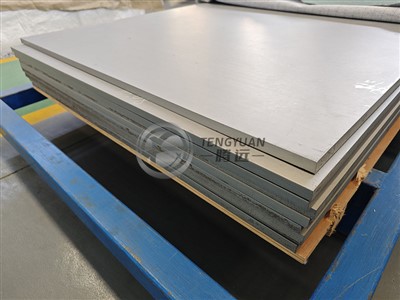
Titanium and its alloys have long been recognized for their exceptional mechanical properties, corrosion resistance, and biocompatibility, making them highly sought - after materials in various industries. Among the numerous titanium alloys, GR12 titanium plates stand out for their unique combination of characteristics. In this blog, we'll explore the acoustic properties of GR12 titanium plates, and as a supplier of GR12 titanium plates, I'll share some insights that could be valuable for potential buyers.


Understanding GR12 Titanium Plates
GR12 titanium alloy is a near - alpha titanium alloy composed mainly of titanium, with small additions of molybdenum and nickel. This alloy offers excellent corrosion resistance, especially in environments containing reducing acids, and it also has good weldability and formability. These features make GR12 titanium plates suitable for a wide range of applications, including GR12 Titanium Plates for Ships and GR12 Titanium Plates for Chemical Industry.
Acoustic Properties of GR12 Titanium Plates
Sound Velocity
The sound velocity in a material is a fundamental acoustic property. In GR12 titanium plates, the sound velocity depends on several factors, such as the material's density, elastic modulus, and crystal structure. Titanium alloys generally have relatively high sound velocities compared to many other metals. For GR12 titanium plates, the longitudinal sound velocity (the speed at which longitudinal waves propagate) is typically in the range of 5000 - 6000 m/s. This relatively high sound velocity makes GR12 titanium plates suitable for applications where fast acoustic signal transmission is required, such as in some ultrasonic testing and underwater acoustic devices.
The high sound velocity is related to the material's high elastic modulus and relatively low density. The elastic modulus of GR12 titanium alloy provides the restoring force for the acoustic waves, while the low density allows the waves to propagate more quickly. This property can be exploited in applications where the rapid detection of acoustic signals is crucial, like in some high - speed industrial inspection systems.
Acoustic Attenuation
Acoustic attenuation refers to the reduction in the amplitude of an acoustic wave as it propagates through a material. In GR12 titanium plates, the acoustic attenuation is relatively low. This is beneficial in applications where the integrity of the acoustic signal needs to be maintained over a certain distance. For example, in underwater acoustic communication systems, low attenuation ensures that the acoustic signals can travel farther without significant loss of strength.
The low acoustic attenuation in GR12 titanium plates can be attributed to the material's homogeneous microstructure and its relatively low internal friction. The well - ordered crystal structure of the titanium alloy reduces the scattering and absorption of acoustic waves, allowing them to travel with less energy loss. This property also makes GR12 titanium plates suitable for use in acoustic resonators, where the ability to maintain a stable acoustic signal is essential.
Acoustic Impedance
Acoustic impedance is a measure of the opposition that a material presents to the flow of acoustic energy. It is defined as the product of the material's density and the sound velocity in the material. GR12 titanium plates have a specific acoustic impedance that is determined by their density and sound velocity.
The acoustic impedance of GR12 titanium plates is important in applications where acoustic coupling between different materials is required. For example, when using GR12 titanium plates in ultrasonic transducers, the acoustic impedance of the plate needs to be matched with the impedance of the piezoelectric element and the medium in which the transducer will operate. A good impedance match ensures efficient transfer of acoustic energy between the different components, improving the overall performance of the ultrasonic device.
Factors Affecting the Acoustic Properties of GR12 Titanium Plates
Heat Treatment
Heat treatment can significantly affect the acoustic properties of GR12 titanium plates. Different heat treatment processes, such as annealing, solution treatment, and aging, can change the material's microstructure, which in turn influences the sound velocity, attenuation, and impedance.
Annealing, for example, can relieve internal stresses in the titanium plates and improve the material's homogeneity. This often results in a more consistent acoustic performance, with reduced variations in sound velocity and attenuation. On the other hand, solution treatment followed by aging can precipitate fine - scale particles in the microstructure, which may increase the acoustic attenuation slightly due to increased scattering of acoustic waves.
Manufacturing Processes
The manufacturing processes used to produce GR12 titanium plates also play a role in determining their acoustic properties. Processes such as rolling, forging, and machining can introduce residual stresses and affect the material's texture.
Rolling, for instance, can create a preferred orientation of the crystal grains in the titanium plates. This texture can cause anisotropy in the acoustic properties, meaning that the sound velocity and attenuation may be different in different directions within the plate. Forging can improve the material's density and reduce porosity, which generally leads to better acoustic performance with lower attenuation and more consistent sound velocities.
Applications Based on Acoustic Properties
Ultrasonic Testing
GR12 titanium plates are widely used in ultrasonic testing applications. Their high sound velocity and low acoustic attenuation allow ultrasonic waves to travel through the plates efficiently, making it easier to detect internal defects such as cracks or inclusions. The well - defined acoustic properties of GR12 titanium plates also enable accurate calibration of ultrasonic testing equipment, ensuring reliable and precise inspection results.
Underwater Acoustic Devices
In the field of underwater acoustics, GR12 titanium plates are valuable materials. Their low acoustic attenuation and high sound velocity make them suitable for use in underwater transducers, hydrophones, and acoustic reflectors. For example, in underwater communication systems, GR12 titanium plates can be used to construct the acoustic coupling elements between the transducer and the water medium, facilitating efficient transmission and reception of acoustic signals.
Comparison with Other Titanium Alloys
When compared with other titanium alloys, such as GR5 Titanium Plates, GR12 titanium plates have some distinct acoustic characteristics. GR5 titanium alloy is a widely used alpha - beta titanium alloy known for its high strength. In terms of acoustic properties, GR5 may have a slightly different sound velocity and attenuation profile compared to GR12.
GR5 titanium plates generally have a higher strength, which may be associated with a slightly higher density and a different elastic modulus. These differences can result in variations in the sound velocity and acoustic impedance. For applications where the acoustic properties need to be precisely tuned, the choice between GR12 and GR5 titanium plates will depend on the specific requirements of the project.
Conclusion
The acoustic properties of GR12 titanium plates, including their high sound velocity, low acoustic attenuation, and specific acoustic impedance, make them suitable for a variety of applications in ultrasonic testing, underwater acoustics, and other fields. As a supplier of GR12 titanium plates, we understand the importance of these acoustic properties and ensure that our products meet the highest quality standards.
If you are interested in purchasing GR12 titanium plates for your specific applications, we invite you to contact us for a detailed discussion. Our team of experts can provide you with more information on the acoustic properties of our GR12 titanium plates and help you select the most suitable products for your needs.
References
- Callister, W. D., & Rethwisch, D. G. (2016). Materials Science and Engineering: An Introduction. Wiley.
- Boyer, R., Welsch, G., & Collings, E. W. (1994). Materials Properties Handbook: Titanium Alloys. ASM International.