Hey there! As a supplier of GR1 Titanium Welding Wire, I often get asked about the thermal conductivity of this product. So, I thought I'd write a blog post to share some insights on this topic.

First off, let's talk a bit about what thermal conductivity is. In simple terms, thermal conductivity is a measure of how well a material can conduct heat. It's an important property, especially in applications where heat transfer is a key factor, like in welding. When you're welding, you want the heat to be transferred efficiently through the welding wire to the workpiece to ensure a good weld.
Now, let's dive into the thermal conductivity of GR1 Titanium Welding Wire. GR1 titanium is an industrial pure titanium grade. It has some really great properties, like high corrosion resistance, good ductility, and relatively low density. But when it comes to thermal conductivity, it's not as high as some other metals.
The thermal conductivity of GR1 titanium at room temperature (around 20°C or 68°F) is approximately 16.3 W/(m·K). To put that in perspective, let's compare it with some other common metals. Copper, for example, has a thermal conductivity of about 401 W/(m·K). That's a huge difference! Copper is an excellent conductor of heat, which is why it's often used in electrical wiring and heat exchangers.
On the other hand, stainless steel, which is also used in a lot of industrial applications, has a thermal conductivity in the range of 14 - 16 W/(m·K). So, GR1 titanium's thermal conductivity is somewhat similar to that of stainless steel.
The relatively low thermal conductivity of GR1 Titanium Welding Wire has both advantages and disadvantages. One of the advantages is that it can help in controlling the heat input during welding. Since the heat doesn't spread as quickly through the wire, it's easier to focus the heat on the welding area. This can lead to better control over the welding process and can result in higher - quality welds.
However, the lower thermal conductivity also means that it might take a bit longer to heat up the wire during the welding process. Welders need to be aware of this and adjust their welding parameters accordingly. For example, they might need to use a slightly higher welding current or a slower welding speed to ensure that the wire melts properly and forms a good bond with the workpiece.
Another factor that can affect the thermal conductivity of GR1 Titanium Welding Wire is temperature. As the temperature increases, the thermal conductivity of GR1 titanium also changes. Generally, the thermal conductivity increases with temperature, but not in a linear fashion. At higher temperatures, the atomic vibrations in the material become more complex, which can influence how heat is transferred.
Now, if you're in the market for titanium welding wire, you might also come across GR2 Titanium Wire. GR2 titanium is another industrial pure titanium grade. It has a slightly higher strength than GR1 titanium, but its thermal conductivity is also similar to that of GR1. At room temperature, the thermal conductivity of GR2 titanium is around 16.7 W/(m·K), which is only a little bit higher than that of GR1.
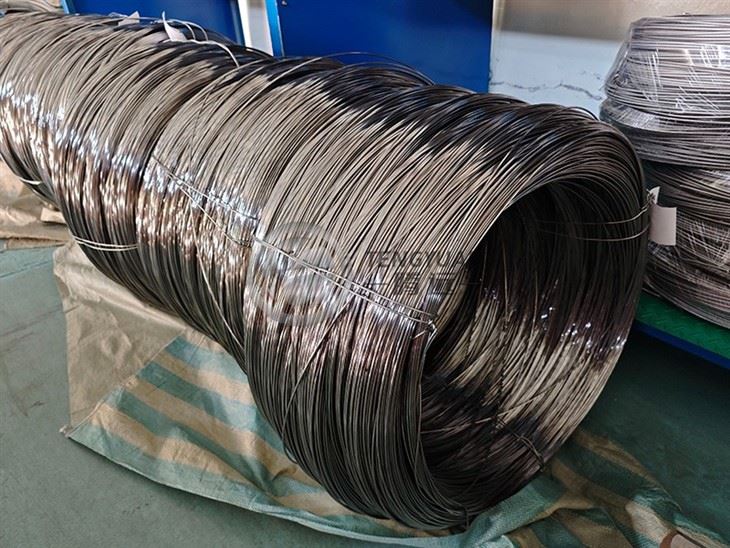
If you're specifically interested in GR1 Titanium Welding Wire, we offer high - quality products. Our GR1 Titanium Welding Wire is manufactured to strict standards to ensure consistent quality. We source the raw materials from reliable suppliers and use advanced manufacturing processes to produce the wire.
The wire has a smooth surface finish, which helps in the feeding process during welding. It also has excellent arc stability, which means that you'll get a more consistent weld bead. And of course, with its known thermal conductivity properties, you can better plan your welding operations.
Whether you're working on a small - scale project or a large - scale industrial application, our GR1 Titanium Welding Wire can be a great choice. We understand that different customers have different requirements, so we offer the wire in various diameters and lengths to meet your specific needs.
If you're thinking about using GR1 Titanium Wire for your next project, it's important to consider the thermal conductivity along with other properties like strength, corrosion resistance, and cost. By understanding how the thermal conductivity affects the welding process, you can make more informed decisions and achieve better results.
So, if you're interested in purchasing GR1 Titanium Welding Wire or have any questions about its thermal conductivity or other properties, don't hesitate to reach out. We're here to help you with all your titanium welding wire needs. Whether you're a professional welder, an engineer, or someone involved in a manufacturing process, we can provide you with the information and products you need.
In conclusion, the thermal conductivity of GR1 Titanium Welding Wire is an important property that affects the welding process. While it's not as high as some other metals, it has its own advantages in terms of heat control during welding. By choosing the right welding parameters and using high - quality GR1 Titanium Welding Wire, you can achieve excellent welding results. So, if you're in the market for this product, give us a chance to serve you. We're confident that our products will meet your expectations and help you succeed in your projects.
References:
- "Titanium: A Technical Guide" by John R. Davis
- Various industry reports on titanium materials and welding processes.