Hey there! As a supplier of GR1 Titanium Wire, I often get asked about the hardness of this amazing material. So, I thought I'd take a deep - dive into it and share what I know with you.
First off, let's understand what GR1 Titanium Wire is. GR1 titanium is an industrial pure titanium. It's known for its excellent corrosion resistance, good formability, and biocompatibility. This makes it a popular choice in a bunch of industries, from aerospace to medical, and even in chemical processing.
Now, when we talk about the hardness of GR1 Titanium Wire, we're dealing with a complex concept. Hardness isn't just a single characteristic. There are different ways to measure it, and each can tell us something different about the material.
One of the most common ways to measure hardness is the Brinell hardness test. In this test, a hardened steel ball is pressed into the material under a certain load, and then the diameter of the indentation is measured. For GR1 Titanium Wire, the Brinell hardness typically ranges from about 120 - 140 HB. This relatively low hardness compared to some other metals might seem like a drawback, but it actually has its perks. The lower hardness makes GR1 Titanium Wire easier to machine. You can cut, shape, and form it into various parts without too much hassle, which is great for manufacturers.
Another well - known hardness measurement is the Rockwell hardness test. There are different scales in the Rockwell test, but for titanium, the Rockwell B scale is often used. GR1 Titanium Wire usually has a Rockwell B hardness of around 70 - 80 HRB. This gives us an idea of how resistant the wire is to indentation. A lower Rockwell B number means the material is softer. And again, this softness can be an advantage in applications where you need to bend the wire or make it into complex shapes.
The Vickers hardness test is also used sometimes. It uses a pyramid - shaped indenter. The Vickers hardness of GR1 Titanium Wire is approximately 130 - 150 HV. The Vickers test is useful because it can be used to test small areas of the material, which is handy when dealing with thin wires.
So, why does the hardness of GR1 Titanium Wire matter? Well, it has a big impact on how the wire can be used. In the aerospace industry, for example, parts need to be strong but also lightweight. The relatively soft nature of GR1 Titanium Wire allows it to be formed into components like brackets and fasteners. These parts can withstand the stresses of flight while still being light enough to contribute to fuel efficiency.
In the medical field, the biocompatibility of GR1 titanium is crucial. The lower hardness means that it can be made into surgical implants, such as pins and plates, that are less likely to cause irritation to surrounding tissues. The material can also be easily shaped to fit the specific needs of the patient.
When comparing GR1 Titanium Wire to other grades, such as GR2 Titanium Wire and GR2 Titanium Welding Wire, GR1 is generally softer. GR2 titanium has a slightly higher hardness because it has a bit more interstitial elements like oxygen and iron. This makes GR2 a better choice for applications where a bit more strength is required, like in some high - stress mechanical parts.
It's important to note that the hardness of GR1 Titanium Wire can also be affected by factors like its manufacturing process. For example, if the wire is heat - treated, its hardness can change. Annealing, which is a heat treatment process, can make the wire softer and more ductile. On the other hand, cold - working the wire can increase its hardness. Cold - working involves processes like drawing the wire through a die, which compresses the metal and makes it stronger.

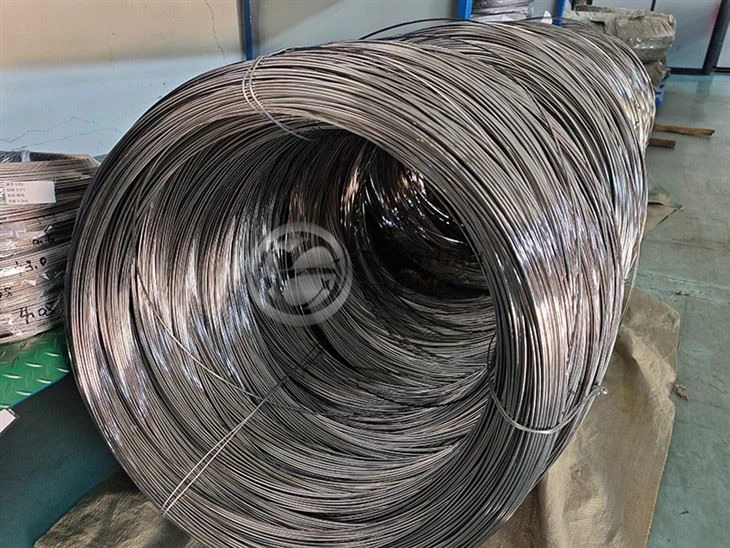
As a supplier of GR1 Titanium Wire, I can offer different levels of hardness depending on your specific application. If you need a wire that's easy to form, we can provide a softer version. If you need a bit more strength, we can offer a wire that's been cold - worked to increase its hardness.
If you're in an industry that could benefit from GR1 Titanium Wire, whether it's aerospace, medical, or something else, and you're not quite sure about the hardness you need for your project, don't hesitate to reach out. We have a team of experts who can help you select the right type of wire based on your requirements. Whether you're prototyping a new product or looking to replace an existing material, we can work with you to find the best solution.
In conclusion, the hardness of GR1 Titanium Wire is an important factor that affects its applications and performance. With its unique hardness properties, it offers a lot of versatility for different industries. If you're interested in learning more or want to start a procurement discussion, just get in touch. We're here to help you get the best GR1 Titanium Wire for your needs.
References:
- Titanium Alloys: Fundamentals and Applications, Edited by R. Boyer, G. W. Welsch, and E. W. Collings
- ASM Handbook Volume 2: Properties and Selection: Nonferrous Alloys and Special - Purpose Materials