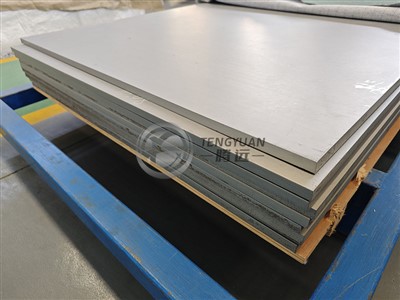
As a supplier of GR2 Titanium Plates, I often encounter various technical inquiries from customers. One of the frequently asked questions is about the specific heat capacity of GR2 titanium plates. In this blog, I'll delve into this topic in detail, explaining what specific heat capacity is, the specific heat capacity of GR2 titanium plates, and its implications in practical applications.
Understanding Specific Heat Capacity
Before we discuss the specific heat capacity of GR2 titanium plates, let's first understand what specific heat capacity means. Specific heat capacity, denoted as (c), is the amount of heat energy required to raise the temperature of a unit mass of a substance by one degree Celsius (or one Kelvin). It is expressed in units of joules per kilogram per degree Celsius ((J/(kg\cdot^{\circ}C))) or joules per kilogram per Kelvin ((J/(kg\cdot K))).
The concept of specific heat capacity is crucial in thermodynamics and heat transfer. Substances with a high specific heat capacity can absorb or release a large amount of heat energy with only a small change in temperature. Conversely, substances with a low specific heat capacity experience a significant temperature change when a relatively small amount of heat energy is added or removed.
Specific Heat Capacity of GR2 Titanium Plates
GR2 titanium is an industrial pure titanium grade. It is known for its excellent corrosion resistance, good formability, and moderate strength. The specific heat capacity of GR2 titanium plates is approximately (520 J/(kg\cdot K)) at room temperature (around 25°C or 298 K). This value can vary slightly depending on factors such as the exact chemical composition of the titanium, its microstructure, and the temperature range.
As the temperature changes, the specific heat capacity of GR2 titanium plates also changes. At lower temperatures, the specific heat capacity generally decreases. As the temperature rises, the specific heat capacity increases gradually. However, this change is not linear. In the range of typical industrial applications, the specific heat capacity remains relatively stable but needs to be considered when dealing with extreme temperature conditions.
Implications in Practical Applications
The specific heat capacity of GR2 titanium plates has significant implications in various practical applications. Here are some examples:
Heat Exchangers
In heat exchanger applications, GR2 titanium plates are often used due to their excellent corrosion resistance. The specific heat capacity of GR2 titanium affects the heat transfer efficiency of the heat exchanger. A relatively high specific heat capacity means that GR2 titanium plates can absorb or release a large amount of heat energy during the heat exchange process. This allows for efficient heat transfer between different fluids without causing excessive temperature changes in the titanium plates themselves.
For example, in a seawater-cooled heat exchanger, GR2 titanium plates can withstand the corrosive environment of seawater while effectively transferring heat from a hot fluid to the seawater. The specific heat capacity of GR2 titanium helps to maintain a stable temperature distribution within the plates, ensuring the long - term performance and reliability of the heat exchanger.
Welding and Heat Treatment
During the welding and heat treatment processes of GR2 titanium plates, the specific heat capacity plays an important role. When welding GR2 titanium plates, a certain amount of heat energy is required to melt the base metal and the filler material. The specific heat capacity determines how much heat energy is needed to reach the melting point and how quickly the temperature can rise and fall during the welding process.
In heat treatment, such as annealing or stress relieving, the specific heat capacity affects the heating and cooling rates. Controlling these rates is crucial to achieving the desired microstructure and mechanical properties of the GR2 titanium plates. If the heating or cooling rate is too fast, it may lead to internal stresses, cracking, or other defects in the plates.
Aerospace Applications
In aerospace applications, GR2 titanium plates are used in various components due to their lightweight and high strength - to - weight ratio. The specific heat capacity of GR2 titanium is important in situations where the components are exposed to rapid temperature changes, such as during takeoff, flight, and re - entry.
For example, in the wings or fuselage of an aircraft, GR2 titanium plates need to withstand the heat generated by air friction during high - speed flight. The specific heat capacity allows the plates to absorb and dissipate this heat energy without significant temperature changes, ensuring the structural integrity and performance of the aircraft.


Comparison with Other Titanium Grades and Materials
It's also interesting to compare the specific heat capacity of GR2 titanium plates with other titanium grades and materials. For instance, compared to GR1 titanium plates GR1 Titanium Plates for Corrosion Resistant, which is another industrial pure titanium grade, the specific heat capacities of GR1 and GR2 are relatively close. GR1 titanium also has a specific heat capacity around (520 J/(kg\cdot K)) at room temperature.
When compared to other common metals, such as steel or aluminum, the specific heat capacity of GR2 titanium plates is different. Steel typically has a specific heat capacity of around (460 J/(kg\cdot K)), while aluminum has a relatively high specific heat capacity of about (900 J/(kg\cdot K)). These differences in specific heat capacity can influence the choice of materials in different applications. For example, in applications where energy storage is important, materials with a higher specific heat capacity like aluminum may be preferred. In contrast, in applications where corrosion resistance and moderate heat transfer are required, GR2 titanium plates are a better choice.
Conclusion
In conclusion, the specific heat capacity of GR2 titanium plates is an important physical property that affects their performance in various applications. With a specific heat capacity of approximately (520 J/(kg\cdot K)) at room temperature, GR2 titanium plates can effectively absorb and release heat energy while maintaining a relatively stable temperature.
Whether you are involved in heat exchanger design, welding and heat treatment processes, or aerospace applications, understanding the specific heat capacity of GR2 titanium plates is crucial for optimizing the performance and reliability of your products.
If you are interested in GR2 Titanium Plates or need more information about their properties and applications, please feel free to contact us for further discussion and procurement negotiation. We are committed to providing high - quality GR2 titanium plates and professional technical support to meet your specific needs.
References
- ASM Handbook Volume 2: Properties and Selection: Nonferrous Alloys and Special - Purpose Materials
- Titanium: A Technical Guide, Second Edition by John C. Williams